Showing posts with label Pandora's false Promise. Show all posts

Tuesday, December 30, 2014

A Nuclear Submariner Challenges a Pro-Nuclear Film


...When I saw “Pandora’s Promise,” I didn’t believe a word of it. I served as a submarine nuclear engineering officer for my four-year stint in the Navy years ago. I qualified as an Engineering Officer of the Watch (a guy who’s in charge of the plant and its other technicians during four-hour shifts) on two different sub reactors. I know the truth about reactors, and the movie replaces it with the demonstrably false Nuclear Dream, a just-so mythical story claiming that nukes are safe, clean and cheap...

READ: A Nuclear Submariner Challenges a Pro-Nuclear Film - NYTimes.com


Tuesday, October 14, 2014

Response: George Monbiot is wrong. Nuclear power is not the way to fight climate change | The Guardian (2011)


from 2011, right after the Fukushima Nuclear Catastrophe began –

Jeremy Leggett
The Guardian, Wednesday 23 March 2011

George Monbiot argues of nuclear energy that the absence of less harmful alternatives has "converted me to the cause" (Why Fukushima made me stop worrying and love nuclear power, 21 March). He says he is driven to his new love by the imperative of battling climate change, and what he sees as the inability of renewable energy to run viable economies.

On the climate imperative, I agree. On the other assertions, I profoundly differ. I speak as someone who founded a renewable energy company because of my fears about climate change and the downsides of dependency on conventional energy. Since I did so, I have watched renewables industries become some of the fastest growing in the world. In 2008 and 2009 more renewables came onstream in both Europe and America than did all fossil fuels and nuclear combined. In Europe in 2009, wind and solar PV alone provided more than half all new generation...


more: Response: George Monbiot is wrong. Nuclear power is not the way to fight climate change | Comment is free | The Guardian


whats up: #BustTheMyth
you can't nuke global warming!


Tuesday, October 7, 2014

▶ Naomi Klein Disagrees with James Hansen on Nuclear Power


Published on Oct 4, 2014 by myla reson

Naomi Klein does not agree with James Hansen's belief that nuclear power is an important component in our collective effort to avert climate catastrophe.

I went to the Hammer Museum on September 30th to hear Naomi Klein speak about her new climate change book *This Changes Everything*

Klein brought up NASA's James Hansen a number of times, so I filled out a 3x5 index card with this question: "Do you agree or disagree with James Hansen's advise that nuclear power is an essential component in our effort to avert climate catastrophe?"

The Q&A was coming to a close - Klein brought up Hansen yet another time when talking about how scientists had responded to the climate crisis - that's where this video begins - and then Robert Greenwald finally asks my question.
I loved Naomi Klein's answer. She started by saying that she loves James Hansen & she hates to disagree with him. She made a brilliant case against nuclear power and when she finished the auditorium exploded in applause - in fact it was the only time during the Q&A that the audience applauded an answer. Does this change everything? I certainly hope so.


whats up: #BustTheMyth
you can't nuke global warming!


Wednesday, September 24, 2014

FOTOS: Nuclear-Free, Carbon-Free at the People's Climate March September 21, 2014


This photo gallery documents the Nuclear-Free, Carbon-Free Contingent at the historic People's Climate March in New York City September 21, 2014. Included are a couple photos from the Nuclear-free strategy meeting on September 20, 2014, preparations for the Contingent in the early morning hours of September 21, speakers at the rally and the march itself. Thank you to everyone who participated and supported this Contingent and made this event possible. Largest Climate March Ever. Largest Nuclear-Free, Carbon-Free Action Ever. We, and our message, are unstoppable. And, together, we WILL build the safe, clean, affordable nuclear-free, carbon-free energy system our planet both needs and deserves. Photos are by Paule Saviano, Lionel Delavigne, Lee Roscoe, Sheila Parks and Michael Mariotte

Nuclear-Free, Carbon-Free at the People's Climate March September 21, 2014


AT NIRS.org –


THANK YOU to the many thousands of people who marched with the Nuclear-Free, Carbon-Free Contingent to the People's Climate March September 21 in NYC. We made history. Largest climate march ever. Largest nuclear-free, carbon-free action ever.

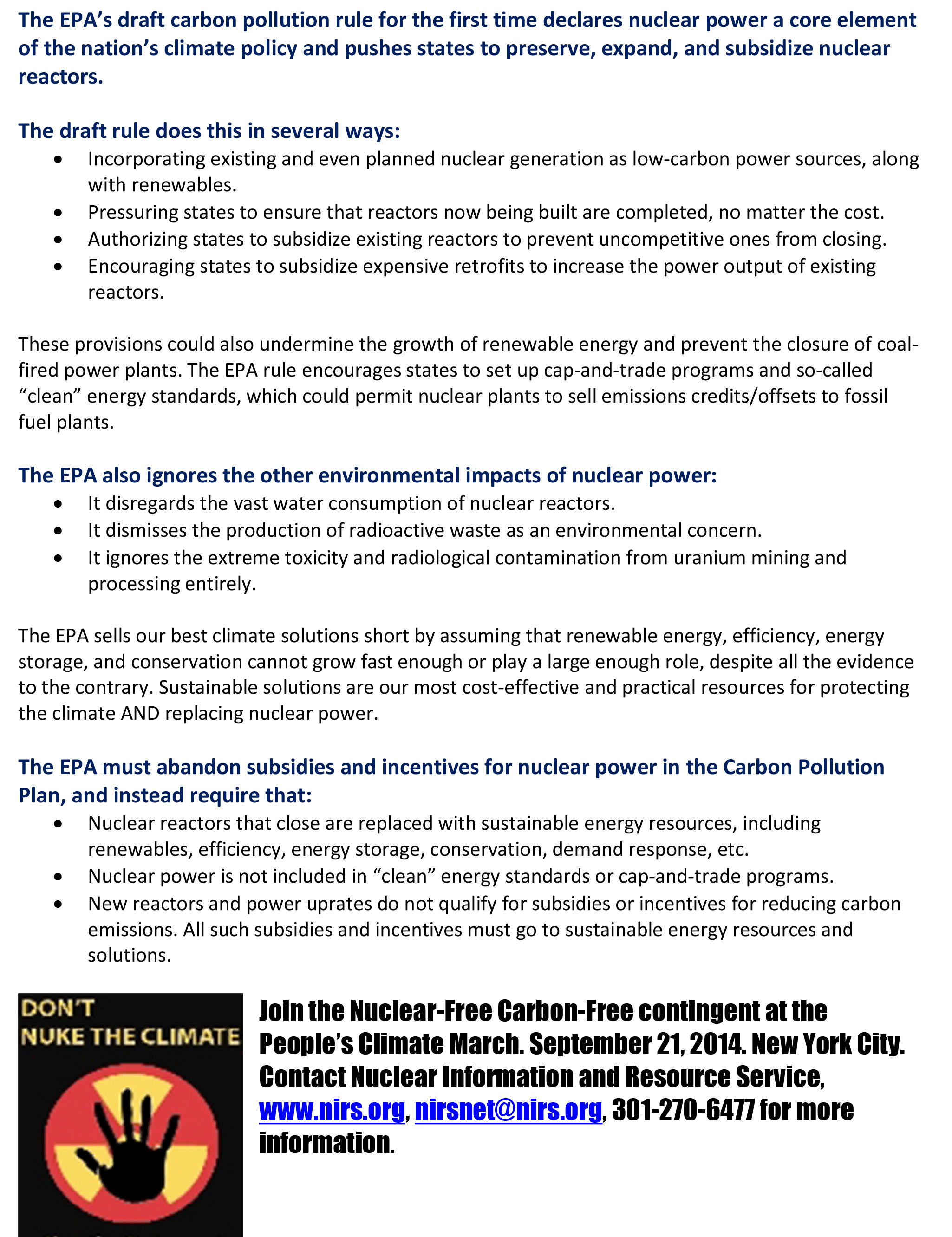
Flyer: Talking Points on nuclear power in EPA's proposed carbon reduction rule. pdf version.jpg version.
Briefing Paper: Nuclear Energy is Dirty Energy (and does not fit in a clean energy standard).pdf

Breaking News
September 11, 2014.

Killing the Competition. The Nuclear Power Agenda to block climate action, stop renewable energy, and subsidize old reactors.

Major new report by NIRS' Executive Director Tim Judson details how major utilities and nuclear power companies have begun a campaign to rig energy markets, climate regulations, and clean energy programs to prevent the advance of renewable energy. Using a deceptive public relations campaign and heavily-funded front groups like Nuclear Matters, Third Way, and C2ES, corporations including Exelon and Entergy have tried to drum up fears of a national energy crisis stemming from the closure of several aging, uncompetitive nuclear plants and the advance of renewable energy. While touting the need to “preserve” nuclear power, nuclear interests have covered up the actual reforms they are seeking and their implications for the U.S.’s energy future.

Audio recording (mp3 file) of press conference release of the report featuring Tim Judson, Dr. Mark Cooper, Vermont Law School, Institute for Energy and the Environment; Tyson Slocum, energy program director, Public Citizen; Deb Katz, executive director, Citizens Awareness Network (New England); David Kraft, executive director, Nuclear Energy Information Service (Illinois); Jessica Azulay, program director, Alliance for a Green Economy (New York).


Nuclear Information and Resource Service - NIRS
http://www.nirs.org/
https://www.facebook.com/nonukesnirs


whats up: #BustTheMyth
you can't nuke global warming!


We made history; now the real work starts | GreenWorld


No matter how you look at it, 400,000 is a lot of people.
It’s not the largest crowd I’ve ever been in: that was the nearly two million at President Obama’s first inauguration. Nor the largest demonstration: that was the million at the 1982 nuclear freeze march in New York City. And the 1970 Atlanta Pop Festival I went to was somewhere around 800,000 (but, of course, who remembers that one? Probably not even many who were there…).

But it’s still a lot of people.
And to put it in a more appropriate perspective, it’s as many or more people than participated in some other seminal events that changed history and the trajectory of American politics and lives: the 1963 civil rights March on Washington, the 1969 Woodstock festival, the November 1969 anti-Vietnam war mobilization, the 1979 No Nukes protest in Washington after Three Mile Island.

Perhaps the world’s governments will simply ignore the legions in the streets–and in the streets of cities and towns all across the world–and continue to do little or nothing to take the steps necessary to quite literally save our planet.
Two days later is far too early to pronounce, or even take a legitimate guess at, the ultimate impact of Sunday’s People’s Climate March.
That would be a tragedy of astronomical proportions...

more > We made history; now the real work starts | GreenWorld


whats up: #BustTheMyth
you can't nuke global warming!


Monday, September 22, 2014

WHY NUKES CAN'T SAVE THE PLANET FROM CLIMATE CHANGE

-- even though the People's Climate March is over, i wanted to re-post all of this very important information -- many thanks to Nuclear Information and Resource Service - NIRS!


Reason #1. Too Many Reactors, Not Enough Carbon Reductions
 pdf version (best for downloading and printing).
 jpg version (best for posting online).
 Word version (take out NIRS contact info and add your group's info).
REASON #1: TOO MANY REACTORS, NOT ENOUGH CARBON REDUCTIONS

Major studies (from MIT, Commission on Energy Policy, and International Atomic Energy Agency, for example) agree that about 1,500-2,000 large new atomic reactors would have to be built worldwide for nuclear power to make any meaningful dent in greenhouse emissions (fewer than 400 reactors now operate globally). If all of these reactors were used to replace coal plants, carbon emissions would drop by only about 20% worldwide. If used as new capacity instead of sustainable technologies like wind power, solar power, energy efficiency, carbon emissions actually would increase.


Reason #2. Nuclear power costs too much.
 
pdf version (best for downloading and printing).
 jpg version (best for posting online).
 Word version(take out NIRS contact info and add your group's info).

REASON #2: NUCLEAR POWER COSTS TOO MUCH
Construction of the 1,500 new reactors (200-300 in U.S. alone) needed for nuclear power to have a significant impact on carbon reductions would cost trillions of dollars. New reactors cost some $7 billion to $15 billion each. Use of resources of this magnitude would make it impossible to also implement more effective means of addressing global warming. Energy efficiency improvements, for example, are some seven times more effective at reducing greenhouse gases, per dollar spent, than nuclear power.


Reason #3. Nuclear Power Would Take Too Long.
 
pdf version (best for downloading and printing).
 jpg version (best for posting online).
 Word version (take out NIRS contact info and add your group's info).
REASON #3: NUCLEAR POWER WOULD TAKE TOO MUCH TIME

Construction of  the 1,500 new reactors needed to make a meaningful dent in carbon emissions would mean opening a new reactor about once every two weeks, beginning today, for the next 60 years—an impossible schedule and much too late to achieve necessary carbon reductions. The world’s nuclear reactor manufacturers currently are capable of building less than half that amount.  Addressing the climate crisis cannot wait for nuclear power.


Reason #4. New Reactor Designs: Too Slow, No Demand.
 
pdf version (best for downloading and printing).
 jpg version (best for posting online).
 Word version (take out NIRS contact info and add your group's info).

REASON # 4: NEW REACTOR DESIGNS: TOO SLOW, NO DEMAND
Some otherwise knowledgeable climate scientists advocate using new, supposedly safer, reactor designs as a climate solution. These untested designs, such as the IFR (Integral Fast Reactor), PBMR (Pebble Bed Modular Reactor), thorium reactors and others, including “small modular reactors,” won’t help either. The designs—all of which have been discussed for decades—exist only on paper and it would take decades more to bring them to commercial operation. To achieve even that would require utilities to want to build them, but none do. Their costs would be even higher than current reactor designs—one reason utilities aren’t interested. Safety-wise, the designs are unproven and would require extensive and time-consuming testing before the federal NRC could license them. Waiting for such reactors to materialize would forestall much faster and cheaper climate solutions.


Reason #5. Too Much Radioactive Waste.
 pdf version (best for downloading and printing).
 jpg version (best for posting online).
 Word version(take out NIRS contact info and add your group's info).

REASON # 5: TOO MUCH RADIOACTIVE WASTE
Operation of the 1,500+ new reactors needed for nuclear power to make a dent in carbon emissions would create the need for a new Yucca Mountain-sized radioactive waste dump every 3-4 years. Yucca Mt. was studied for 20 years before being dropped by President Obama as a nonviable waste solution. International efforts to site radioactive waste facilities are similarly behind schedule and face substantial public opposition. For this reason, the nuclear industry wants to reprocess nuclear fuel as a waste management tool—a dirty, dangerous and failed technology that increases nuclear proliferation risks.


Reason #6. Too Little Safety.
 pdf version (best for downloading and printing).
 jpg version (best for posting online).
 Word version (take out NIRS contact info and add your group's info).

REASON # 6: TOO LITTLE SAFETY
Odds of a major nuclear disaster are said to be on the order of 1 in 10,000 reactor-years, but experience shows accidents occur even more frequently. Operation of some 1,500 reactors needed for nuclear power to play a meaningful role in reducing carbon emissions could result in a Fukushima-scale nuclear accident every five years—a price the world is not likely to be willing to pay. And more reactors means more potential terrorist targets.


Reason #7. Too Many Nuclear Weapons.
 pdf version (best for downloading and printing).
 jpg version (best for posting online).
 Word version(take out NIRS contact info and add your group's info).


REASON # 7: TOO MANY NUCLEAR WEAPONS
Operation of the 1,500 or more new reactors necessary for nuclear power to play a meaningful role in reducing carbon emissions would require a dozen or more new uranium enrichment plants, and would result in the production of thousands of tons of plutonium (each reactor produces about 500 pounds of plutonium per year), posing untenable nuclear proliferation threats.


Reason #8. Nukes are not carbon-free. 
pdf version (best for downloading and printing). 
jpg version (best for posting online). 
Word version (take out NIRS contact info and add your group's info).


REASON # 8: NUKES ARE NOT CARBON-FREE
While nuclear reactors themselves are not major emitters of greenhouse gases, the nuclear fuel chain produces significant greenhouse emissions. This chain includes uranium mining, milling, processing, enrichment, fuel fabrication, and long-term radioactive waste storage. At each of these steps, construction and operation of nuclear facilities results in carbon emissions. Taken together, the fuel chain greenhouse emissions are more than double solar power emissions, which are declining as the industry becomes more efficient, and some six times higher than wind power—not to mention emissions-free energy efficiency technologies.


Reason #9 Nukes are not suited for warming climates.
pdf version (best for downloading and printing). 
jpg version (best for posting online). 
Word version (take out NIRS contact info and add your group's info).

REASON # 9: NUKES ARE NOT SUITED FOR WARMING CLIMATES
Unlike solar power, nuclear power does not work well in warming climates. Reactors require vast quantities of water to keep the core cool; changes in water levels, and even water temperatures, can greatly affect reactor operations. Reactors in the U.S. and elsewhere have been forced to close during heat waves, when they’re needed the most. Ever-stronger storms, like Hurricane Sandy, also threaten to inundate both coastal and inland reactors. More frequent tornados, ice storms and related loss-of-power accidents, and other indicators of climate change also imperil reactors. The Fukushima accident was caused primarily by loss-of-power, not direct damage from the tsunami or earthquake. Rising sea levels threaten coastal reactors with flooding even without mega-storms.


Reason #10 A Nuclear-Free, Carbon-Free energy system is safer, cleaner, cheaper and faster at reducing carbon emissions.
 pdf version (best for downloading and printing). 
jpg version(best for posting online). 
Word version (take out NIRS contact info and add your group's info).


REASON # 10: A NUCLEAR-FREE, CARBON-FREE ENERGY SYSTEM IS SAFER, CLEANER, CHEAPER AND FASTER AT REDUCING CARBON EMISSIONS
If we could meet our electricity needs without radioactive waste, nuclear meltdowns, releases of carbon and methane and all the other environmental destruction associated with extraction of nuclear and fossil fuels from the Earth, why wouldn’t we? Just a few years ago, solar and wind power weren’t competitive with nuclear power or fossil fuels. Now, both are usually cheaper than the polluting power choices. It is increasingly affordable for homeowners to install solar power plants on their rooftops—a new solar rooftop system is installed in the U.S. every 4 minutes, a number that will drop to every 90 seconds by 2016.

Smart grids, distributed generation and other 21st century technologies enable the large-scale use of renewables despite their variable nature. And advances in battery and other storage technologies mean that both rooftop solar and larger-scale renewable power plants can provide power 24/7—just like the behemoth nuclear and coal “baseload” power plants of the 20th century.

Numerous studies show conclusively that a nuclear-free, carbon-free energy system is attainable before mid-century. The technology is not the issue; only political will now stands in the way. Our choice is stark: we can choose nuclear power, or we can address global warming. We can’t do both. Fortunately, the choice is an easy one.


Nuclear Power and Climate: Why Nukes Can't Save the Planet.
NIRS' basic 1 sheet factsheet: Perfect for downloading, printing, and distributing (pdf format).

http://www.nirs.org/factsheets/nukesclimatefact614.pdf
- includes all the above info, plus this:


Most people don’t realize just how fast clean renewable energy is growing nor how low its costs are plummeting. Just a few years ago, solar and wind power weren’t competitive with either nuclear power or fossil fuels. Now, both are usually cheaper than the polluting power choices.

Increasingly, it is both feasible and economical for homeowners to install their own solar power plants on their rooftops — a new solar rooftop system is installed in the U.S. every four minutes, a number that will reach every 90 seconds during 2016. Smart grids, distributed generation and other 21st century technologies enable the large-scale use of renewables despite their intermittent nature. On one day in May 2014, 74% of Germany’s power was provided by renewables, a level skeptics said could never be reached.

And advances in battery and other electricity storage technologies mean that both rooftop solar and larger-scale renewable power plants increasingly and affordably provide power 24/7—just like the behemoth nuclear and coal “baseload” power plants of the 20th century.

Investing our resources in clean energy— renewables and energy efficiency --gives us much more bang for the buck: instead of a 20% reduction in carbon emissions with nuclear power, we can get a 100% reduction — and that’s a goal worth working for. Numerous studies show conclusively that a nuclear-free, carbon-free energy system is both attainable and affordable before mid-century. The technology is not the issue; only political will stands in the way.


Our choice is stark: we can choose nuclear power, or we can address global warming. We can’t do both. Fortunately, the choice is an easy one. --Michael Mariotte, June 2014


whats up: #BustTheMyth
you can't nuke global warming!


Saturday, September 20, 2014

More Nuclear Power is NOT the Answer to the Climate Crisis :: PETITION


PETITION

More Nuclear Power is NOT the Answer to the Climate Crisis
This petition was published by Tom Hayden on Sep 04, 2014

We urge you to revise the recommendations of the UN's Sustainable Development Solutions Network to remove its advocacy of nuclear fission as a "solution" to the climate crisis. The accelerated development of nuclear power plants would only increase the course we are on to planetary catastrophe.

We urge you to develop an analytic model that includes the decommissioning of current nuclear plants as part of a transition to a future based on conservation, efficiency and renewable energy.


image: Gail Payne


VIDEO – Speakers at September 15, 2014 at UN Church Center in conjunction with the NYC People’s Climate March September 21st and the United Nations Climate Summit 2014


▶ Nuclear Power Is Not the Answer to Climate Change - YouTube

Nuclear experts and activists speak about issues associated with nuclear power – such as Fukushima, nuclear waste, uranium mining, human rights, health, economic, and technical issues – and discuss why nuclear energy is not “clean” energy nor a solution to climate change.

Speakers, in order, Tim Judson, Arnie Gundersen, Leona Morgan, Alfred Meyer, Marilyn Elie, and Mari Inoue. September 15, 2014 at UN Church Center in conjunction with the NYC People’s Climate March September 21st and the United Nations Climate Summit 2014 starting September 23rd. Video by Joe Friendly


whats up: #BustTheMyth
you can't nuke global warming!


Friday, September 19, 2014

▶ Nuclear Power Is Not the Answer to Climate Change - VIDEO


▶ Nuclear Power Is Not the Answer to Climate Change - YouTube


Nuclear experts and activists speak about issues associated with nuclear power – such as Fukushima, nuclear waste, uranium mining, human rights, health, economic, and technical issues – and discuss why nuclear energy is not “clean” energy nor a solution to climate change.

Speakers, in order, Tim Judson, Arnie Gundersen, Leona Morgan, Alfred Meyer, Marilyn Elie, and Mari Inoue. September 15, 2014 at UN Church Center in conjunction with the NYC People’s Climate March September 21st and the United Nations Climate Summit 2014 starting September 23rd. Video by Joe Friendly


PETITION

More Nuclear Power is NOT the Answer to the Climate Crisis
This petition was published by Tom Hayden on Sep 04, 2014

We urge you to revise the recommendations of the UN's Sustainable Development Solutions Network to remove its advocacy of nuclear fission as a "solution" to the climate crisis. The accelerated development of nuclear power plants would only increase the course we are on to planetary catastrophe.

We urge you to develop an analytic model that includes the decommissioning of current nuclear plants as part of a transition to a future based on conservation, efficiency and renewable energy.

> SIGN NOW


see also:

whats up: reasons nukes can't save the planet | 9.21 PEOPLES CLIMATE MARCH, NYC: nuclear-free, carbon-free contingent


whats up: #BustTheMyth
you can't nuke global warming!